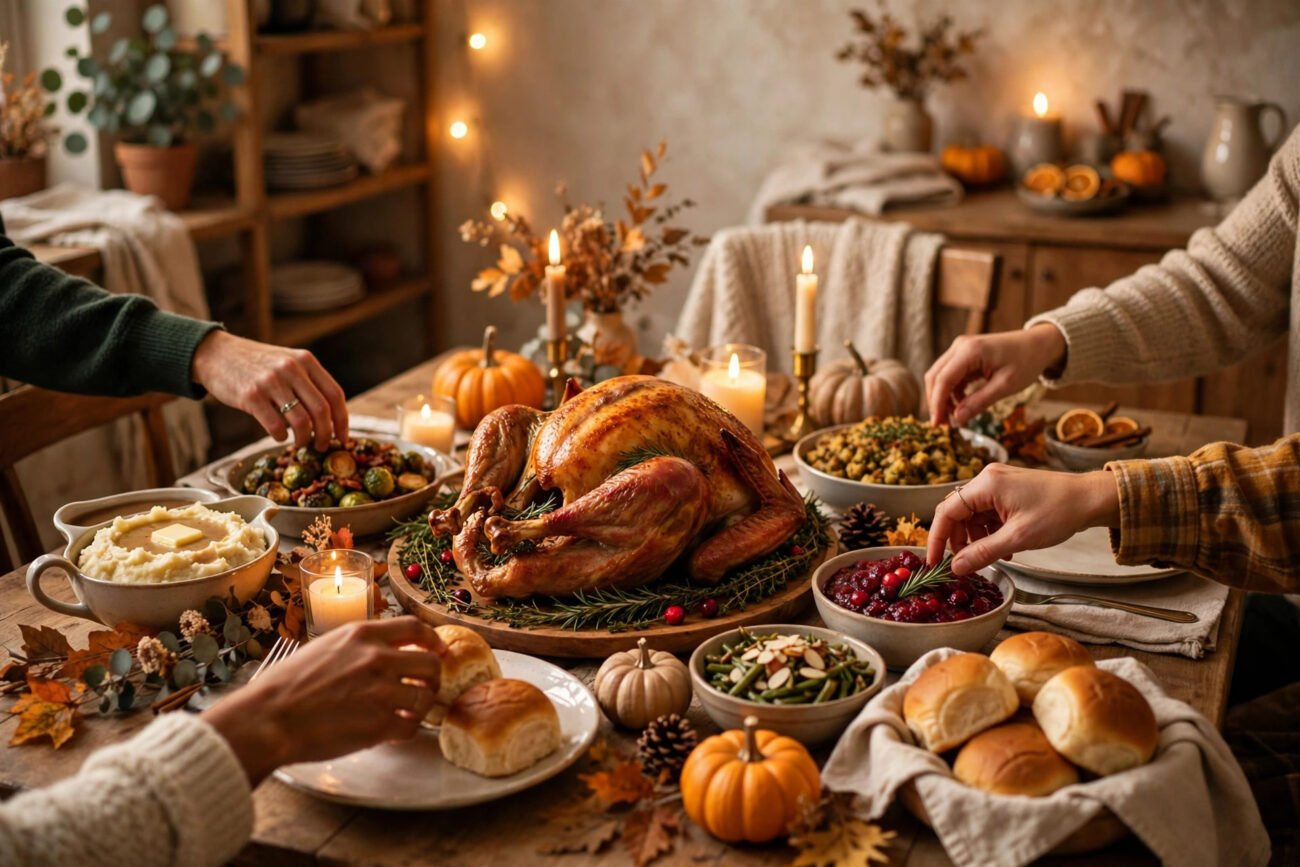
Friendsgiving has a simple premise: Thanksgiving dinner, but with the people you chose. No family politics, no childhood seating chart, no one asking about your life plans over the gravy. Just friends, a big meal, and an evening that belongs to all of you. It sounds easy — and it mostly is — but the difference between a relaxed, laughing evening and a stressed host hiding in the kitchen usually comes down to decisions made weeks earlier, not cooking skill.
This guide is written for the first-time host: the person with a small apartment or a first house, a mixed group of friends who may not all know each other, and a budget that is not infinite. It covers the whole job, from the first text message to the last leftover box.
First, What Is Friendsgiving, Really?
Friendsgiving is a Thanksgiving-style feast celebrated with friends instead of family. The name took off in the late 2000s, as a generation of young adults living far from home started building their own holiday traditions with the people around them. There are no rules about when it happens — most hosts pick a weekend in the two weeks before Thanksgiving, or the Wednesday night before, so it never collides with anyone’s family plans. Some groups celebrate on Thanksgiving Day itself, especially when several friends cannot travel home.
The only real tradition is the spirit of it: everyone contributes, nobody is performing, and the meal is an excuse for the gathering rather than the other way around. If your group wants turkey and all the classics, great. If your group wants tacos and a pie contest, that is Friendsgiving too.
Step 1: Pick Your Format Before You Invite Anyone
Three formats cover almost every successful Friendsgiving, and choosing one early prevents most hosting headaches.
Potluck (best for most first-timers). You cook the main dish and maybe one side; every guest brings a dish, a dessert, or drinks. The workload spreads out, the table gets more variety than any one cook could manage, and guests feel like co-hosts rather than an audience. The risk — three mac and cheese dishes and no dessert — is solved with a shared sign-up sheet, covered below.
Host cooks everything (best for small groups of 4–6). You control the menu and the timing, and the evening feels more like a dinner party. It costs more and takes a full day of cooking, so keep the guest list small and the menu short: one main, three sides, one dessert.
Brunch (best for small spaces and tight budgets). A late-morning gathering with egg dishes, pastries, fruit, and one showstopper like a breakfast casserole or pumpkin French toast. It is cheaper, faster to cook, and over by early afternoon — and nobody has to deep-clean a kitchen at midnight.
Whichever format you choose, decide the guest count with your space, not your ambitions. A good rule: if everyone cannot sit down to eat at the same time, the list is too long for a sit-down dinner — switch to a buffet, where guests serve themselves and sit wherever there is room.
Step 2: The Timeline That Keeps You Calm
Hosting stress is almost always a timing problem. Here is the schedule that fixes it.
Three weeks out: Send the invitations. A group text is perfectly fine — Friendsgiving is casual by definition — but give a date, a start time, and the format (potluck, host-cooks, or brunch) in the first message, so nobody has to ask. Share the sign-up sheet at the same time: a simple shared document or a group message thread where guests claim categories — main, side, dessert, drinks, ice, plates — not specific recipes. Claiming categories is what prevents duplicate dishes.
One week out: Confirm the headcount and the menu. Text anyone who has not signed up yet and assign them something easy — dinner rolls, a bag of ice, a bottle of wine, a store-bought pie. These are also perfect jobs for friends who do not cook, and for last-minute additions to the guest list. Plan your own cooking now: if you are making the turkey, remember the thawing rule — a full day in the refrigerator for every four pounds, so a 16-pound bird needs four days. Buy it early or buy fresh.
The day before: Do everything that does not need an oven. Chop vegetables, make sauces and cranberry sauce, bake pies, set the table, and put drinks on ice in the fridge. If your space is small, this is also the day to rearrange: move a bookshelf or a side table out of the dining area, put a folding table against the wall as a buffet station, and stack seating you do not need in another room. A small space feels generous when the food station is separate from the eating area.
Party day, hour by hour: Put the main dish in the oven first thing — it needs the longest, and everything else fits around it. Two hours before guests arrive, set out appetizers that do not need attention: a cheese board, nuts, crudités. Thirty minutes before, put drinks and glasses where guests can help themselves, so you are not pouring drinks all night. When guests arrive, give them one job each if they ask what they can do — «put the rolls in the oven» or «open the wine» — because people who are helping are people who are comfortable. Eat when the food is ready, not when the clock says so. After dessert, do a fifteen-minute group reset: everyone clears their own plate, leftovers go into the take-home boxes you bought in advance, and the kitchen becomes manageable instead of a midnight project.
Step 3: Hosting in a Small Space
Small-space hosting is not a lesser version of the real thing — it is just a different layout. A buffet setup is your best friend: food on one surface, drinks on another, and every seat in the room available for eating. If you have more guests than chairs, floor cushions, a coffee table, and a couple of folding chairs make the room feel intentional rather than cramped, as long as every seat has a plate and a drink within reach.
Decorations should work hard and take no floor space. A table runner, candles (unscented, so they do not fight the food), and a bowl of small pumpkins or a few sprigs of greenery make a table feel festive without a centerpiece that blocks conversation. If you have a patio or balcony and the weather holds, spillover seating outside with blankets doubles your space for free.
And do not apologize for the size of your place. Guests remember how they felt, not how many square feet you had — and a full, warm, slightly crowded room is the feeling Friendsgiving is supposed to produce.
Step 4: Feeding Everyone Without Losing Your Mind
Two details separate a good Friendsgiving table from a stressful one: labels and options. Put a small card next to each dish naming it and flagging the common dietary notes — vegetarian, vegan, gluten-free, contains nuts. Guests with dietary needs can then serve themselves confidently instead of interrogating every cook, and the friend who brought the vegan dish gets credit for it.
For the menu itself, think balance, not abundance. One main, two or three sides, one or two desserts, and one signature drink — a big-batch punch or a pot of spiced cider — covers a table beautifully. A punch is the best hosting trick in this whole guide: it serves a crowd, it costs less than individual drinks, it can be made non-alcoholic with sparkling juice, and the bowl itself becomes a centerpiece.
On budget, potluck is already the cheapest format, but two more moves help: make the main dish something that feeds a crowd cheaply (a turkey breast instead of a whole bird, a glazed ham, or a slow-cooked pork shoulder), and ask guests to bring drinks, which are the most expensive and least memorable part of any party.
Step 5: When Not Everyone Knows Each Other
Many Friendsgiving guest lists mix friend groups — college friends, work friends, a partner’s friends — and the host’s real job is making strangers comfortable, not just feeding them. Three small moves do most of the work. First, introduce people with a connection, not just a name: «Priya, this is Marcus — you both ran a marathon this year» gives two strangers a first sentence. Second, put a conversation starter on the table: a stack of cards asking everyone to write down one thing they are grateful for this year, read aloud after dinner. It sounds corny and it works every single time. Third, have one low-effort game ready — a card game, a trivia round, or a simple board game — for the stretch after dessert when energy dips and people start checking their phones.
Step 6: Leftovers and the Day After
Buy inexpensive take-home containers before the party and announce at the start of the evening that everyone takes a box home. It is the most loved Friendsgiving tradition after the meal itself, it empties your fridge, and it saves you from eating turkey sandwiches for a week. The next day, send one message to the group: thank everyone, share the photos, and suggest a date for next year. Groups that do this once tend to do it every year — and that, more than any recipe, is the point.
Friendsgiving works because it is the one holiday meal where nobody is a guest and nobody is staff. Everyone brings something, everyone helps a little, and the evening belongs to the whole table. If you are still deciding whether to host, here is the honest answer: send the text. The worst version of Friendsgiving is the one that never happens.
If your group is gathering around Thanksgiving itself, our 7-day gratitude reset is a gentle way to slow down before the holiday rush, and if anyone is traveling for the occasion, send them our Thanksgiving trip-home survival guide — the return trip is the hardest part of the holiday.
