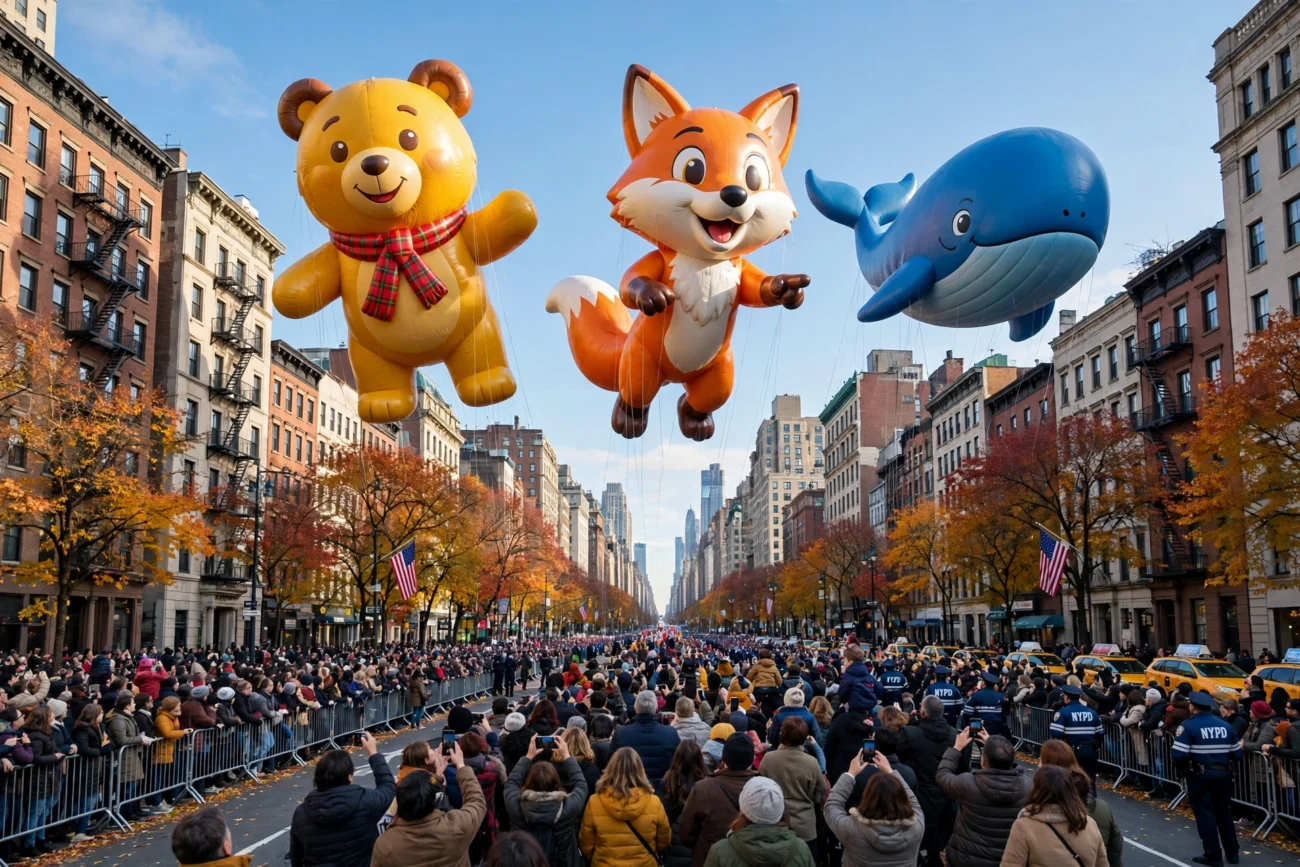
Every Thanksgiving morning, millions of Americans do the same thing before the turkey goes in the oven: they turn on the television and watch giant balloons drift down the streets of New York City. It feels timeless, as if the parade has always been there, floating somewhere between breakfast and dinner. It has not. The Macy’s Thanksgiving Day Parade began as a modest, slightly chaotic idea from the store’s own employees, it featured live animals borrowed from a zoo, and for its first years it was not even called a Thanksgiving parade at all. How it grew from that into the morning ritual we know now is one of the best stories in American holiday history.
It Started With Immigrants Who Missed Home
The story begins in 1924, not with a marketing department, but with Macy’s workers. Many of the store’s employees at the time were recent immigrants from Europe, and as the holiday season approached, they wanted to celebrate in the way they had back home: with a public festival, a parade through the streets, music, and costumes. They took the idea to Macy’s leadership, who agreed — and saw, quite rightly, that a parade ending at the company’s flagship store would also be excellent publicity.
The first parade, held on Thanksgiving morning in 1924, was advertised as the Macy’s Christmas Parade. Its real purpose was to welcome Santa Claus to New York and to open the Christmas shopping season at the newly expanded Herald Square store, which then covered an entire city block. About 10,000 Macy’s employees marched, along with professional entertainers, floats, bands, and — most memorably — live animals on loan from the Central Park Zoo, including elephants, camels, and bears. More than a quarter of a million people lined the route to watch, on a course that stretched about six miles from 145th Street in Harlem down to Herald Square. It was a success from the first year, and Macy’s made it annual.
Why the Animals Had to Go
Live animals turned out to be a wonderful idea in theory and a frightening one in practice. The zoo animals roared, and the roars scared the children lining the route. Within a few years, Macy’s needed a replacement that was just as spectacular but considerably less alarming. The answer came in 1927, when the store hired Tony Sarg, a puppeteer and illustrator who had designed its holiday window displays, to create something new.
Sarg’s solution was the giant balloon. Working with the Goodyear Tire and Rubber Company, he designed huge animal-shaped balloons, held aloft and guided by handlers on the ground. The very first parade balloon was Felix the Cat, and the effect was immediate: the balloons were enormous, friendly, and impossible to ignore, and they gave the parade a signature that no other holiday event could copy. In the same year, the event took the name it still carries today: the Macy’s Thanksgiving Day Parade.
The early balloons came with a strange tradition of their own. From 1928 through 1931, at the end of the parade, the balloons were simply released into the sky, with a reward offered to anyone who returned one. The practice stopped in 1932, which is probably just as well: a giant Felix the Cat drifting over New Jersey was charming, but it was not a sustainable system.
The Parade Grows Up: Radio, War, and the Movies
Through the 1930s, the parade kept growing. Crowds passed one million, and beloved characters joined the lineup — Mickey Mouse made his parade debut in 1934, beginning a long relationship between the parade and the characters children already loved. The parade was first broadcast on the radio in 1932, and local television coverage followed in the 1940s, with national network broadcasts beginning in 1948. Suddenly a New York street parade belonged to the whole country.
Then came the one interruption in the parade’s history. From 1942 to 1944, the parade was suspended during World War II, when rubber and helium were needed for the war effort. The balloons were deflated and donated to the government, providing about 60 pounds of scrap rubber. When the parade returned in 1945, it came back to a country ready to celebrate again — and two years later, it became a household name in a new way, when footage of the 1946 parade appeared in the film Miracle on 34th Street. The movie’s Santa Claus, and its famous department store setting, fixed the parade in the national imagination for good.
How the Balloons Actually Work
If you have only ever watched the parade on television, it is easy to assume the balloons simply float along. In reality, each one is a small engineering project. Modern parade balloons are made of polyurethane-coated fabric, inflated with helium, and guided by teams of trained handlers holding ropes. The largest balloons can be several stories tall, and they are flown at heights carefully chosen for the wind and the width of the street. On a windy year, balloons fly lower, which is why some Thanksgivings look a little more grounded than others — safety, not spectacle, sets the altitude.
The floats are engineered just as carefully. Macy’s creative teams have designed and built the floats in-house since 1968, and each float is built to fold down for transport: a float that stands up to 40 feet tall and 28 feet wide on the route can collapse into a box roughly 12.5 feet by 8 feet for the journey to the starting line. That folding trick is one of the parade’s quiet marvels — a whole fantasy world, packed flat, then unfolded in the streets of Manhattan.
And then there is the finale, which has never changed. Every parade ends the same way it did in 1924: with Santa Claus arriving at Herald Square, officially opening the Christmas season. It is the one moment that connects the very first parade to every one since, and it is why the parade still feels like a beginning rather than just a show.
The Parade Route and How to Watch It
Today’s route is much shorter than the original six miles. The parade now travels about 2.5 miles, from West 77th Street and Central Park West, down Central Park West and Sixth Avenue, to Macy’s Herald Square at 34th Street. Around 3.5 million people watch in person in New York City, and more than 50 million more watch on television, where the parade traditionally airs on NBC from 8:30 a.m. to noon Eastern time.
If you are planning to watch in person, the best advice is the simplest: arrive early, dress warmly, and do not aim for Herald Square itself, which is the most crowded and restricted part of the route. Good viewing can be found along Central Park West from West 77th down to West 61st Street, and along Sixth Avenue from West 59th to West 38th Street. Bring patience, a hot drink, and a plan for where to go afterwards — the crowds leaving the route are part of the experience, and the nearby streets fill up fast.
If you are watching from home, the television broadcast is the classic way to do it, and it is worth remembering what you are actually watching: not just a parade, but a live event with real weather, real wind, and real handlers working hard to keep a giant balloon on course. That unpredictability is part of the charm. A balloon that dips in a gust, a marching band that plays a little too enthusiastically, a float that wobbles — these are the moments people talk about afterwards.
The Records, the Characters, and the One Older Parade
Over more than a century, the parade has collected its share of records and trivia. Snoopy holds the record for the most balloons in parade history, appearing in more versions than any other character. More than 100 animated characters have appeared as balloons over the years. And in a detail that surprises many fans, Macy’s parade is not actually America’s oldest Thanksgiving parade: that honour belongs to a parade hosted by the Gimbel Brothers department store in Philadelphia, first held in 1920, four years before Macy’s. Philadelphia’s parade began the same way Macy’s did, as a store promotion dressed up as a celebration, and it is still going today.
The parade has also kept reinventing its lineup. New balloons and floats debut almost every year, reflecting whatever children are watching and reading at the time, while older favourites return again and again. That balance — new characters beside old friends, the same route, the same Santa finale — is why the parade survives every change in fashion. It is familiar without being frozen.
Why It Still Matters
It is easy to be cynical about a parade started by a department store to sell Christmas presents. The first parade was, unapologetically, a piece of marketing. But what it became is something else: a shared morning ritual in a country that does not have many of them. On Thanksgiving, before families scatter to kitchens and dining rooms, millions of people watch the same balloons, hear the same bands, and wait for the same Santa. It is a rare moment when the holiday is communal before it becomes private.
That is the real legacy of those immigrant employees in 1924. They wanted a celebration that felt like home, and they accidentally built one that feels like home to millions of other people, most of whom have never set foot in New York. The animals are gone, the route is shorter, and the balloons are bigger than Tony Sarg could ever have imagined. But the idea is unchanged: once a year, on a cold November morning, a city stops, looks up, and lets itself be delighted.
For more American holiday stories, see our guide to New York City in November, the real history of why Thanksgiving dinner looks the way it does, and why Americans carve pumpkins.

Un comentario en «How a 1924 Employee Parade Became America’s Thanksgiving Morning»