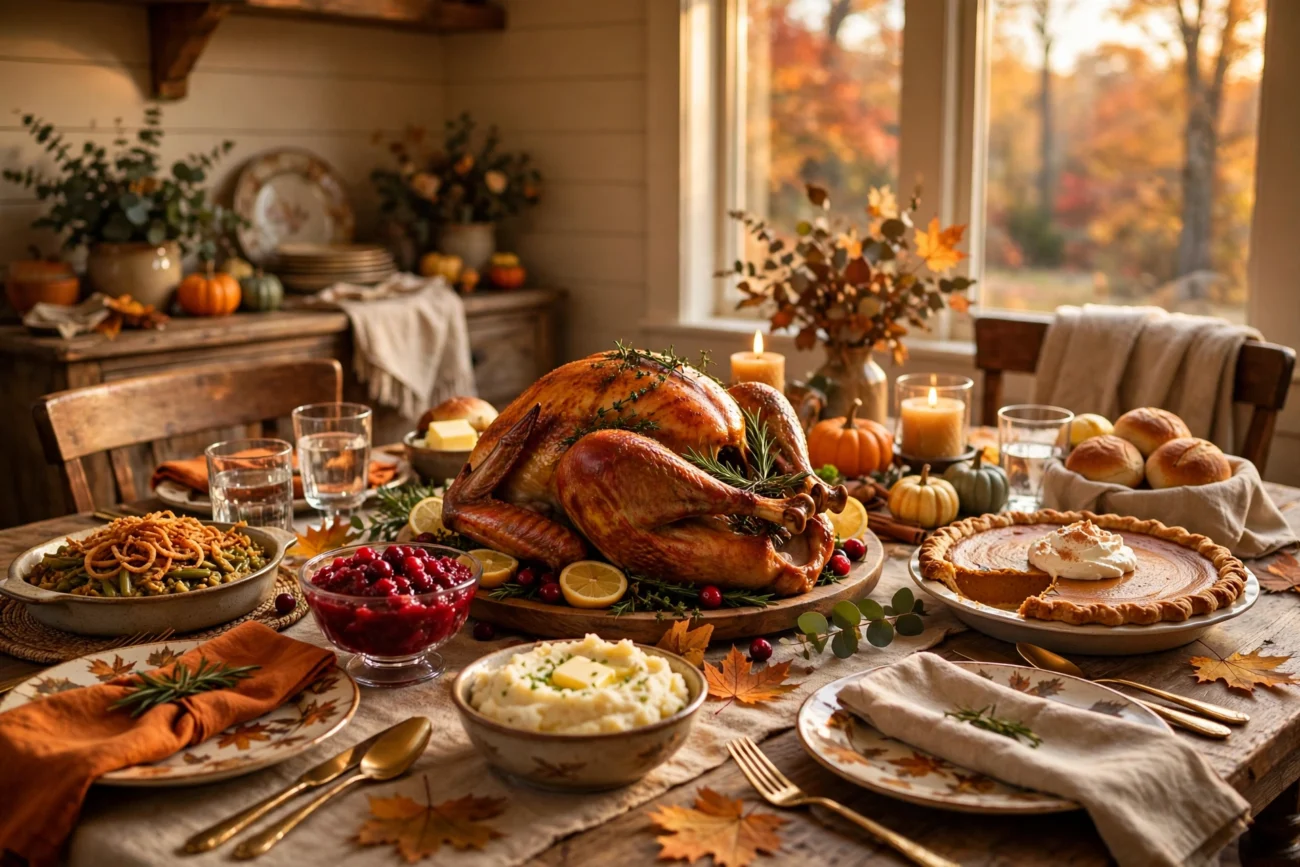
Every November, millions of American tables end up looking almost exactly the same: a roasted turkey in the middle, stuffing and gravy close by, mashed potatoes, cranberry sauce, sweet potatoes, and pumpkin pie to finish. It feels timeless, as if the menu was handed down, unchanged, from a single feast in 1621. The real story is stranger, longer, and much more interesting — because most of the Thanksgiving dinner we know was not served at the first Thanksgiving at all. It was assembled over centuries, from English feasts, Native American ingredients, a novelist’s campaign, a president’s proclamation, and a canning industry that put cranberry sauce on every table.
What Was Actually on the Table in 1621
The feast we call the first Thanksgiving was a three-day harvest celebration in the fall of 1621, shared by the English settlers at Plymouth and their Wampanoag neighbors, who had helped the colony survive its first brutal year. We know surprisingly little about its menu, because only one firsthand account survives — a brief paragraph by Edward Winslow — and it does not list dishes at all. It mentions five deer brought by the Wampanoag guests, and fowl hunted by the settlers.
Historians piece together the rest from what was available in New England that autumn: wild turkey, duck, goose, and other wild birds; venison; fish, eel, and shellfish such as clams, mussels, and lobster; beans, peas, corn, squash, turnips, onions, and leeks; nuts and wild berries. What was not there is just as telling. There was no pumpkin pie, because the settlers had almost no flour, butter, sugar, or molasses left, and no ovens for a proper crust. There was no cranberry sauce as we know it, because without sugar, cranberries were far too tart to enjoy. There was no stuffing, no mashed potatoes — potatoes had not yet become a staple in New England — and no sweet potato casserole with marshmallows, a much later invention.
Pumpkins were there, but they were boiled, stewed, or roasted over coals, sometimes hollowed out and filled with milk, honey, and spices and cooked in the ashes. It was good food, and a genuine celebration of a harvest that meant survival. It just was not the dinner on your table.
Why Turkey? It Was Already Famous in Europe
The turkey is the biggest surprise of all, because it did not become the centerpiece simply by being local. Turkeys are native to North America, but domesticated turkeys had already been taken to Europe in the 1500s, where they were quickly adopted as a fashionable feast bird — similar in spirit to the peacocks and pheasants that graced wealthy tables. When English colonists arrived in New England, they already knew turkey, and soon after landing they were importing domesticated birds from Europe.
Turkey also suited the occasion. A large bird feeds a large gathering, it carves dramatically at the table, and carving at the table was itself a fashionable European ritual in the 1600s, complete with illustrated carving manuals and a whole vocabulary for how to serve each bird. The Thanksgiving turkey, in other words, is not a dish invented in America from scratch. It is a European feast tradition, rebuilt with an American bird.
By the 1800s, turkey had become the expected centerpiece of a grand American dinner, and Thanksgiving gave it a yearly stage. The bird’s size helped: one turkey could feed an extended family in a way a chicken never could, and its place at the head of the table turned the meal into a ceremony, with the carver — traditionally the head of the household — performing the first cut.
Cranberries, Pumpkin, and the Medieval Spice Cupboard
Cranberry sauce has a similarly double history. Cranberries themselves are native to North America, and Native peoples used them long before colonization. But the idea of serving a sour fruit sauce with roast fowl came straight from medieval Europe, where a cold, tart condiment was the classic partner for hot, rich meat. In the mid-1600s, the French chef La Varenne was serving turkey with raspberries in exactly this spirit. American cooks applied the same logic to the local berry, and once sugar became affordable, cranberry sauce as we know it — sweet, tart, jewel-red — took its place beside the turkey for good.
Pumpkin pie’s story runs on a parallel track. Sweet pies were an English invention, and the first printed recipes to include pumpkin appeared in England in the 1650s, with sliced pumpkin in crusts or cooked inside the shell. One of the earliest English cookbook writers, Hannah Woolley, published a recipe for «pompion-pye» seasoned with the same spices we use today: cinnamon, nutmeg, clove, and ginger. Those spices were the backbone of medieval cooking, imported from Asia at great expense, and a lavish meal was hardly complete without them. By the 1700s, pumpkin pie had become a popular holiday dish in New England, and it never left.
Sweet potatoes, meanwhile, originated in South America and reached North America through Caribbean trade and, as historians note, through the slave trade — a reminder that the Thanksgiving table, like American cooking itself, was built by many hands, including hands that are too often left out of the holiday story.
The Woman Who Invented the Modern Thanksgiving
If one person deserves credit for the Thanksgiving we celebrate, it is not a Pilgrim. It is Sarah Josepha Hale, a New England writer and the editor of Godey’s Lady’s Book, the most widely read women’s magazine of its day. In her 1827 novel Northwood, Hale described an idealized New England Thanksgiving dinner — turkey, stuffing, gravy, vegetables, and pumpkin pie — in warm, nostalgic detail. Then she spent decades campaigning to make Thanksgiving a national holiday, writing editorials and letters to governors and presidents, asking each to proclaim the last Thursday in November as Thanksgiving Day.
By 1860, thirty-three states and territories were celebrating on the same day, but the Civil War interrupted her campaign. Hale wrote to President Abraham Lincoln, and in 1863, hoping to give a divided nation a shared day of gratitude — and to mark Union victories at Gettysburg and Vicksburg that summer — Lincoln proclaimed Thanksgiving a national holiday. The date later settled, by law, on the fourth Thursday in November, which is why Thanksgiving 2026 falls on Thursday, November 26.
Hale’s idealized dinner became the template. Cookbooks, magazines, and later food companies repeated it until it felt ancient, even though much of it had been assembled in the 1800s. The green bean casserole, a dish many families now consider essential, was not invented until the 1950s, when a Campbell’s Soup Company home economist created it as a way to use canned soup. The canned cranberry sauce that slides out of the can in a perfect cylinder — a shape many families defend fiercely — dates to the early 1900s, when cranberry growers began canning the sauce for year-round sale. Tradition, it turns out, keeps being invented.
How Immigrants Made the Table Their Own
One of the most American things about Thanksgiving dinner is how it changes from house to house. Immigrants who had never celebrated Thanksgiving in their own countries adopted the holiday readily, kept the turkey, and added dishes from their own heritage: Italian families with lasagna beside the turkey, Mexican American families with tamales, Chinese American families with roast duck or sticky rice stuffing, and countless families with a side dish that only makes sense if you grew up with it.
That variety is not a break from tradition. It is the tradition. The Thanksgiving table has always been a mix of Native American ingredients, European cooking methods, and whatever the people at the table brought with them. Even the meal’s timing — an early-afternoon dinner, rather than an evening supper — echoes the way a proper dinner was served four hundred years ago, when the main meal of the day came early and supper was a smaller evening meal. Football came later; the early dinner did not start to make room for the game.
A Table Worth Understanding, Not Just Repeating
None of this makes Thanksgiving dinner less special. If anything, knowing its history makes it richer: the turkey carries a European feast tradition and an American bird; the cranberry sauce carries a medieval idea about balancing flavors; the pumpkin pie carries spices that once crossed oceans; and the whole meal carries the work of a magazine editor who believed a shared dinner could hold a country together.
It also makes room for honesty about the holiday’s harder history. For many Native Americans, Thanksgiving is observed as a National Day of Mourning, remembering the centuries of loss that followed 1621. A table that knows its real story — a harvest feast between neighbors that did not stay peaceful, a menu invented over centuries, a holiday proclaimed in wartime — is a better table than one built on a simple myth.
So this November, when the turkey comes out of the oven and the cranberry sauce takes its place, you will know what you are really celebrating: not a single meal from 1621, but four centuries of cooks, writers, farmers, and families who kept adding a dish, changing a recipe, and making room for one more person at the table. That is a tradition worth keeping.
For more on the season, see our guide to why Americans love Halloween, our first-timer’s guide to hosting a Friendsgiving dinner party, and our story of how pumpkin spice became America’s favorite fall obsession.

Un comentario en «Why Thanksgiving Dinner Looks the Way It Does: The Real History of Turkey, Cranberry Sauce, and Pumpkin Pie»