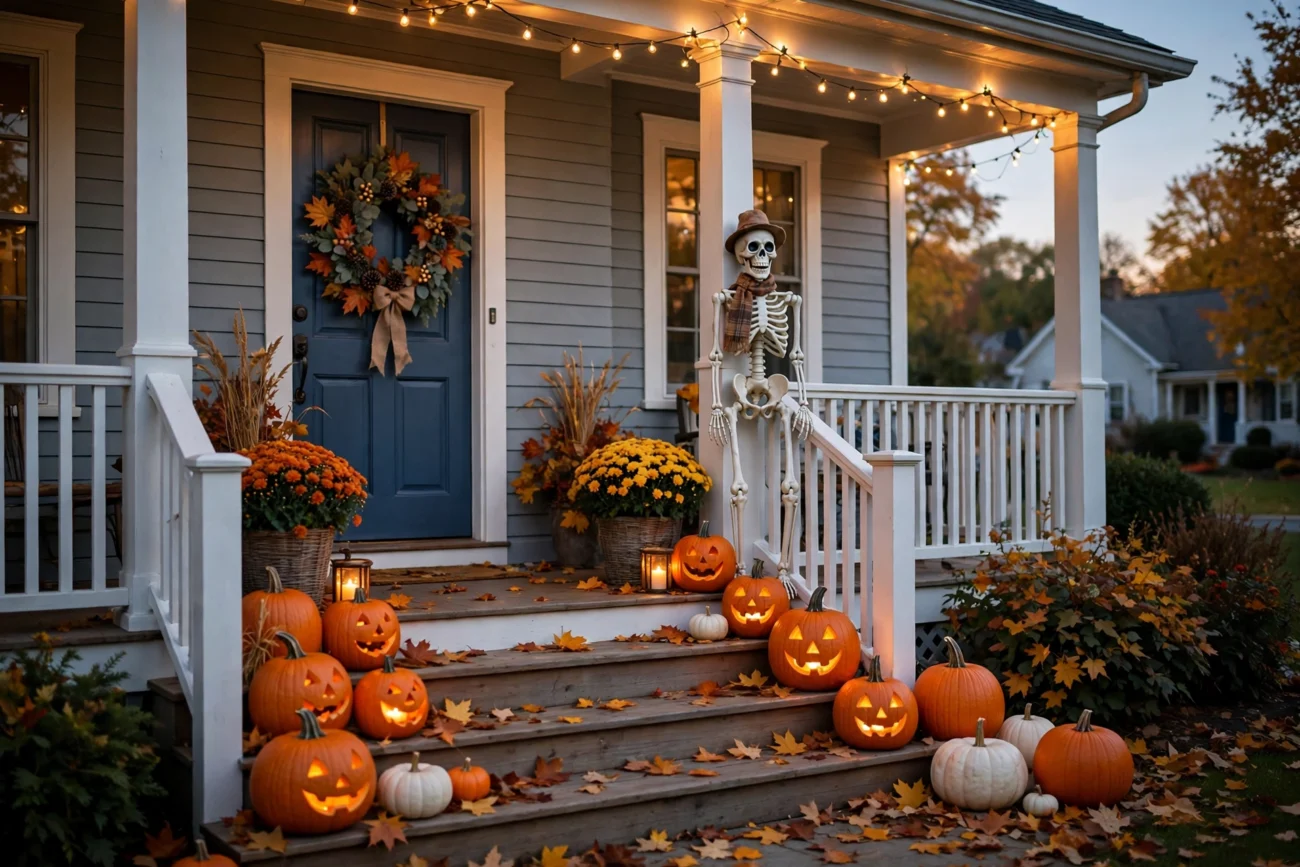
If you land in the United States any time in October, you will notice something odd: front yards full of tombstones, skeletons climbing out of flower beds, and pumpkins grinning from every porch. Halloween is technically one night — October 31 — but for Americans it has quietly become a whole season. Around three quarters of consumers say they celebrate it in some way, and total spending has topped $13 billion in recent years, according to the National Retail Federation. So why does this country go so completely all-in? Here are the traditions behind the madness.
Where It All Comes From
Halloween’s roots reach back more than 2,000 years to Samhain, a Celtic festival marking the end of the harvest and the beginning of winter. The Celts believed that on that night the boundary between the world of the living and the world of the dead grew thin, and they lit bonfires and wore disguises to ward off wandering spirits. The name itself comes from All Hallows’ Eve, the evening before the Christian feast of All Saints’ Day on November 1, which over the centuries blended with the older Celtic observances. Irish and Scottish immigrants carried these customs to America in the 1800s, where they mixed with harvest festivals, church observances, and plain old neighborhood fun. The result is a holiday that is equal parts ancient ritual and modern block party — and as we noted in our guide to American traditions that surprise visitors, few of them puzzle newcomers quite like this one.
10 Halloween Traditions Americans Take Seriously
1. Trick-or-Treating
The centerpiece of the night. As soon as it gets dark, costumed kids pour into the streets with pillowcases and plastic pumpkins, going door to door calling «trick or treat!» The ritual has older cousins in Britain and Ireland — «souling» and «guising,» where people performed songs or prayers in exchange for food — but it became a true American institution in the 1950s, once wartime sugar rationing ended and candy companies got involved. There are unwritten rules everyone knows: a porch light on means welcome, a dark house means skip it, and it is perfectly acceptable for a parent to «inspect» the candy afterward (and keep a tax of the good chocolate). Most towns run the whole show in the early evening, roughly between 5:30 and 9 p.m., and many publish official trick-or-treat hours. Older kids eventually face the great unspoken question — am I too old for this? — but in most neighborhoods, a teenager in a real costume with good manners will still get candy.
2. Carving Jack-o’-Lanterns
In Ireland and Scotland, people once carved frightening faces into turnips. In America, immigrants found the pumpkin — bigger, softer, and far easier to carve — and a new icon was born. The name comes from the Irish folktale of «Stingy Jack,» a trickster doomed to wander the earth with only a carved vegetable for a lantern. Today, families visit pumpkin patches in early October, pick their specimens, and spend an evening scooping seeds and cutting faces, from classic triangle eyes to elaborate works of art lit with candles or LED lights.
3. Costumes for Absolutely Everyone
Costumes began as disguises meant to confuse spirits, but they have become the holiday’s engine of creativity. Kids plan theirs for months — superheroes, princesses, and witches are perennial favorites — and adults have fully joined in, with office costume contests and themed parties. Even pets get dressed up: pumpkins and hot dogs remain the most popular dog costumes year after year. For many families, the annual costume photo is as much a keepsake as any Christmas card.
4. Haunted Houses
Some people pay good money to be terrified, and America delivers. The commercial haunted house took off in the 1970s, when local Jaycees chapters ran them as fundraisers, and it has grown into an industry of professional attractions with movie-quality sets and actors who take their screaming very seriously. On the home front, plenty of neighborhoods have one legendary house — converted garage, fog machine, a teenager in a mask — that kids dare each other to walk through. Some home haunters spend weeks building walk-through mazes in their driveways and happily accept donations to charity at the door. Bigger destinations, like Salem, Massachusetts — famous for its 1692 witch trials — stretch the scares across an entire month of «Haunted Happenings,» drawing crowds that rival the town’s population many times over.
5. Decorating Like It’s Christmas
For decorating enthusiasm, Halloween is second only to Christmas in the United States. It starts modestly — a wreath, a few pumpkins — but many homes now feature full yard scenes: inflatable ghosts, animatronic witches, graveyards with pun-filled tombstones, and synchronized light shows. Hardware stores sell out of giant skeletons (a 12-foot one from a home improvement chain became a genuine cultural phenomenon a few years back). Whole streets coordinate themes, and driving around to look at Halloween houses has become a family outing in itself, much like the small towns in our roundup of cozy small towns to visit this fall, where Main Street storefronts compete for the spookiest window display.
6. Costume Parties for Grown-Ups
Halloween is no longer a children’s holiday that adults merely supervise. Grown-up costume parties are a fixture of the last weekend in October, complete with costume contests, themed cocktails, and prizes for the most creative (or most obscure) references. Cities host Halloween parades and bar crawls, and New York’s Village Halloween Parade draws enormous crowds of costumed marchers every year. For adults, the appeal is simple: it is the one night a year when showing up to a party dressed as a pirate, a dinosaur, or a walking taco is not just allowed but applauded.
7. The Great Candy Economy
Candy is the fuel of Halloween, and the numbers are staggering in plain terms: Americans spend several billion dollars on Halloween candy alone each year, and candy is the single most common Halloween purchase. Supermarkets build entire aisles of «fun size» bags weeks in advance, and the debate over the best haul — chocolate bars versus candy corn, a chewy classic invented in the 1880s — is a genuine annual argument in American households. The etiquette matters, too: households that hand out full-size bars earn legendary status on their street, while everyone remembers exactly which house gave out toothbrushes.
8. Trunk-or-Treat
A newer tradition, trunk-or-treat events popped up in the 1990s and 2000s and are now everywhere. Churches, schools, and community groups line up cars in a parking lot, decorate the open trunks, and hand out candy from each one. It gives little kids a shorter, well-lit route, gives parents a contained space, and gives participants an excuse to turn a minivan into a pirate ship. In rural areas where houses sit far apart, trunk-or-treat has often become the main event rather than a backup plan.
9. Pumpkin Patches and Corn Mazes
October weekends belong to the farm visit. Families drive out to pick pumpkins straight from the field, get pleasantly lost in corn mazes, ride hay wagons, and drink fresh apple cider. Farms have built entire fall festivals around the season, with haunted hayrides after dark for the older crowd. The town of Anoka, Minnesota — which held one of the first organized Halloween parades in the country back in 1920 and calls itself the «Halloween Capital of the World» — shows how deep this harvest-season pride runs in American communities.
10. Scary Movie Nights
When the porch light finally goes off, the night ends the same way in millions of homes: lights down, popcorn out, horror movie on. Television channels run month-long horror marathons through October, classic slashers get rewatched like comfort food, and families with younger kids queue up gentler fare — friendly ghosts and silly witches. Watching something scary together, half-hiding behind a blanket, is the cozy exhale at the end of all the chaos.
So Why Do Americans Go All-Out?
The enthusiasm now starts astonishingly early, too: stores roll out skeletons and candy in late summer, a trend fans half-jokingly call «Summerween,» and nobody really objects. Strip away the candy and the costumes, and Halloween succeeds because it asks so little and gives so much. There are no gifts to buy, no formal dinner to host, no travel required — just a costume, a bowl of candy, and your own street transformed for one night. It is one of the few holidays where neighbors genuinely interact: you meet the people behind every door on your block, kids learn the geography of their own neighborhood, and everyone, from toddlers to grandparents to the dog, gets to play. That is why October 31 keeps growing. It is not really about being scared. It is about a whole country agreeing, once a year, to be a little bit silly together.

3 comentarios en «Why Americans Love Halloween: 10 Traditions That Make October 31 Unforgettable»