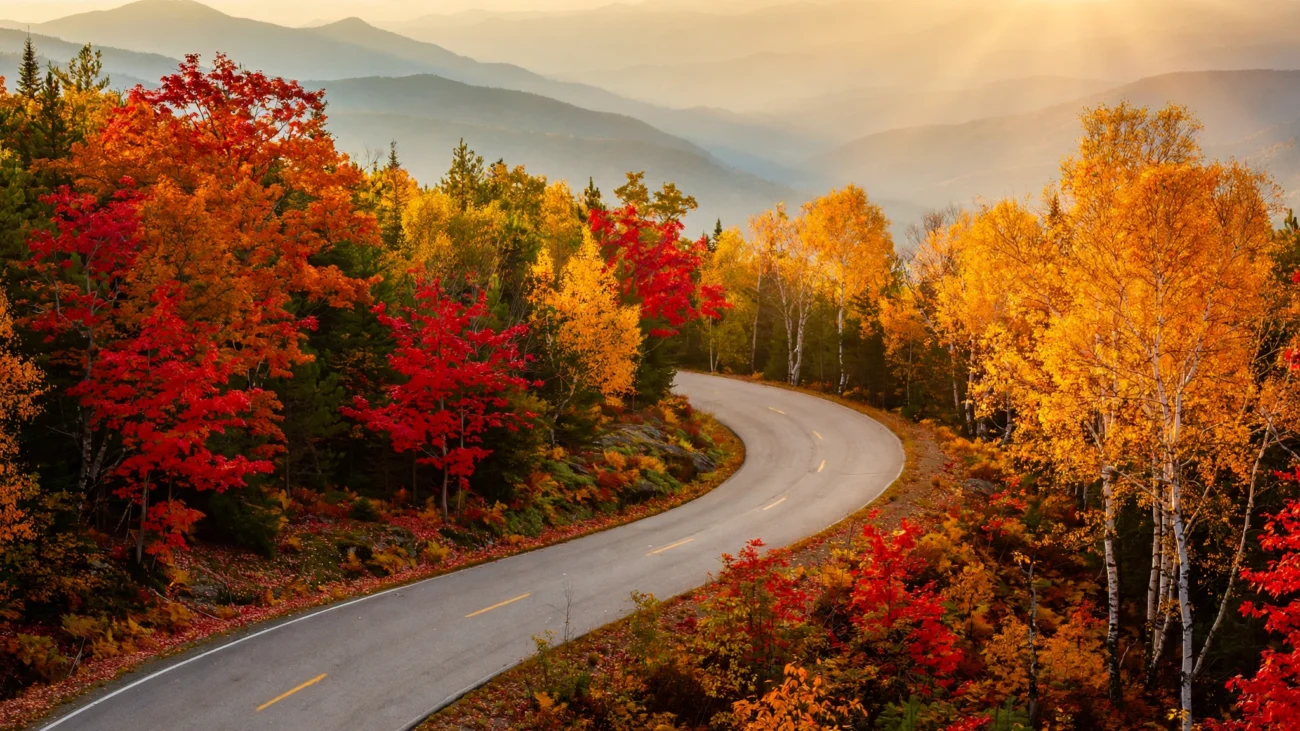
There is a short window every autumn when the maples turn scarlet, the birches go gold, and even a routine drive feels like a postcard. The tricky part is timing. Peak color sweeps down the country like a slow wave — starting in the northern woods in late September and finishing in the southern hills in early November — and each spot gets roughly two good weeks, sometimes less.
Below are twelve reliable places to catch fall foliage at its peak, roughly in the order the color arrives, with when to go and what to do there.
First, How Peak Season Moves
Elevation matters as much as latitude. Leaves change first where nights turn cold earliest — high mountains and northern forests — then color «slides» downhill and southward week by week. That’s why the Smokies can be green in the valleys while the ridgelines are already orange. Rule of thumb: New England and the Great Lakes peak from late September to mid-October, the mid-Atlantic and Midwest in mid-to-late October, and the southern mountains hold color into early November. Check a local foliage report before you travel — weather shifts timing by a few days each year.
1. Michigan’s Upper Peninsula
The UP is where the American foliage season kicks off. Sugar maples set the forests around Marquette and Munising ablaze, usually from late September into mid-October. Drive to Tahquamenon Falls, where the Upper Falls — about 50 feet tall and 200 feet across — pours amber-colored water through peak maples. Then continue to Pictured Rocks National Lakeshore, where the same fiery trees top sandstone cliffs above Lake Superior. It’s a longer drive than most trips on this list, and that’s exactly why it rarely feels crowded.
2. Kancamagus Highway, New Hampshire
Locals just call it «the Kanc,» and for about 34 miles between Lincoln and Conway, this two-lane road through White Mountain National Forest is the most famous foliage drive in the country. No gas stations, no billboards — just pullout after pullout overlooking the Swift River and layer upon layer of color. Peak typically arrives in early to mid-October. Stop at Sabbaday Falls for an easy walk to a postcard waterfall, and start early on weekends — by 10 a.m. half of New England has had the same idea.
3. Route 100 and the Mad River Valley, Vermont
Vermont’s Route 100 runs down the spine of the Green Mountains, and the Mad River Valley towns of Waitsfield and Warren make a perfect base. This is classic Vermont: covered bridges, white church steeples, farm stands selling cider donuts, and hillsides where maples seem to outnumber the evergreens. Color peaks in early to mid-October. Spend a morning driving the Appalachian Gap if you’re comfortable with steep, winding roads, and save an afternoon for farm stores and a creemee stand — Vermont’s beloved soft-serve.
4. Acadia National Park, Maine
Acadia adds something no inland forest can: ocean. On the 27-mile Park Loop Road, scarlet maples grow down to pink granite shores, and from the top of Cadillac Mountain — the highest point on the US East Coast at 1,530 feet — sunrise lights up whole islands of color. Peak foliage usually lands in early to mid-October. Rent a bike for the carriage roads, gravel paths winding past stone bridges and quiet ponds, and warm up afterward with popovers at Jordan Pond House, a tradition since the late 1800s.
5. The Catskills and Hudson Valley, New York
Two to three hours from New York City, the Catskills deliver a Hudson River School painting in real life. Hike to Kaaterskill Falls, a two-tier waterfall dropping roughly 260 feet, or ride the Hunter Mountain Skyride for a lazy panorama. Valley towns like Hudson, Rhinebeck, and Kingston fill the trip out with farm markets, orchards, and antique shops. Higher peaks color up in early October, while the valley floor peaks mid-month — a mid-October trip lets you see both in one weekend.
6. The Finger Lakes, New York
New York’s Finger Lakes region pairs its foliage with waterfalls and wine. At Watkins Glen State Park, the gorge trail passes 19 waterfalls in about two miles, with stone bridges arching over pools ringed by red and gold trees. Over in Ithaca, Taughannock Falls drops 215 feet — taller than Niagara — in a single plunge. Between hikes, the vineyards along Seneca and Cayuga Lakes turn gold, and harvest season means tasting rooms are pouring new wines. Expect peak color around mid-October.
7. Cuyahoga Valley National Park, Ohio
Ohio’s only national park is the Midwest’s most underrated foliage trip. The Cuyahoga River winds between Akron and Cleveland through woods that peak in mid-to-late October, and the best seat in the house is the Cuyahoga Valley Scenic Railroad, which runs a fall excursion train through the heart of the park. On foot, the Ledges Trail loops past mossy rock formations under beech and maple, and Brandywine Falls is one of the tallest waterfalls in Ohio. Basing yourself in a nearby town? Our guide to cozy small towns in the US to visit this fall has more slow-weekend inspiration.
8. Shenandoah National Park, Virginia
Shenandoah was practically designed for leaf-peeping. Skyline Drive runs 105 miles along the crest of the Blue Ridge Mountains with 75 overlooks, so you’re never far from a pull-off where the whole valley spreads out below in patchwork color. Oaks, hickories, and maples usually peak in mid-to-late October. Break up the drive with a short hike — Dark Hollow Falls is an easy 1.4-mile round trip — and linger at Big Meadows, where deer graze at dusk.
9. Blue Ridge Parkway, North Carolina
The southern half of the Blue Ridge Parkway, from Blowing Rock down to Cherokee, is a greatest-hits reel of Appalachian fall. The road runs 469 miles in total with no stoplights and a 45 mph speed limit, and the North Carolina section stacks the deck: the Linn Cove Viaduct hugging Grandfather Mountain, the open meadows of Graveyard Fields, and mile-high overlooks near Mount Mitchell, the tallest peak east of the Mississippi. Because elevation varies so much, something is at peak almost all of October — higher elevations early in the month, the valleys near Asheville later.
10. Great Smoky Mountains, Tennessee and North Carolina
America’s most-visited national park also has one of its longest foliage seasons, thanks to more than 5,000 feet of elevation change. The high country around Kuwohi (formerly Clingmans Dome) turns in early October; the middle slopes — the sweet spot, full of scarlet oak and sugar maple — peak from mid-to-late October; and low spots like Cades Cove hold on into early November. Drive the Foothills Parkway for the mid-elevation show with a fraction of the traffic, and go early to beat Cades Cove’s famous October line of cars.
11. Columbia River Gorge, Oregon
Out West, the Columbia River Gorge is the standout. Bigleaf maples turn gold along the cliffs east of Portland, and the waterfalls do the rest: Multnomah Falls drops 620 feet in two tiers past a stone bridge, and the Historic Columbia River Highway threads past half a dozen more falls, each framed in autumn color. Peak usually arrives in mid-to-late October. Stop in Hood River for fresh pears and apples at harvest season, and keep a rain jacket handy — gorge weather likes to keep you guessing.
12. Mount Magazine and the Arkansas Ozarks
If October is nearly over and you’ve missed everything up north, head for Arkansas. The Ozarks are among the last places in the country to peak, typically from late October into early November. Mount Magazine, the state’s highest point at 2,753 feet, looks out over oak and hickory turning russet and gold, and the lodge on top makes an easy overnight. Pair it with the Pig Trail Scenic Byway, about 19 miles of curves through the Boston Mountains, and the Victorian streets of Eureka Springs.
When to Go: Tips for Catching Peak Color
- Chase elevation, not just dates. If a spot has already peaked, drive downhill or south; if it’s still green, head uphill. A few hundred feet can buy you a week.
- Book early, go midweek. Foliage weekends sell out small-town inns fast. A Tuesday-to-Thursday trip gets the same trees with half the traffic.
- Get out early. Morning light makes reds and oranges glow, overlooks are emptier, and you’ll beat the tour buses to the trailheads.
- Pack for two seasons. Mountain overlooks can be 15 degrees colder than the valley, with wind on top. Layers and shoes that can handle muddy trails will save the day. Flying in? These creative ways to make your luggage stand out help you spot your bag fast and get on the road.
- Lean into the season. Leaf-peeping pairs perfectly with apple picking, pumpkin patches, and harvest festivals — the kind of classic autumn rituals we explored in our look at American traditions that surprise visitors. Plan one orchard stop and the trip feels complete.
Frequently Asked Questions
When is peak fall foliage in the US?
It depends on where you go. Northern New England and the Great Lakes usually peak from late September to mid-October; the mid-Atlantic, Midwest, and southern Appalachians follow in mid-to-late October; and the Ozarks and lower southern valleys can hold color into early November.
Which state has the best fall foliage?
Vermont and New Hampshire are the famous answers, and they earn it — but the «best» trip is the one you can time right. A mid-October weekend in the Smokies at true peak beats a famous Vermont drive a week too late.
How long does peak color last?
At any single spot, roughly one to two weeks, though wind and heavy rain can strip trees faster. That’s why elevation-hopping within one region is the smartest strategy.
Peak foliage is the most forgiving trip on the calendar: no tickets, no lines for the main event — just a tank of gas, a thermos of something warm, and a road through the trees. Pick your region, watch the foliage reports, and go while the color lasts.

3 comentarios en «12 Best Places in the US to See Fall Foliage at Its Peak»