Picture a Los Angeles cemetery on a late-October night — not silent and spooky, but wide awake. Mariachi trumpets echo between the headstones, candlelight shimmers off rows of marigolds, and families spread out picnics beside decorated graves while kids with painted faces chase each other past the altars. This is Día de los Muertos — and it hasn’t belonged to Mexico alone for a long time.
A generation ago, most Americans met the holiday through a sugar skull printed on a T-shirt. Then Pixar’s Coco (2017) arrived, and suddenly millions of kids — and their parents — were weeping over a cartoon great-great-grandmother. The film lit a match under American curiosity. Today you can walk a Day of the Dead procession in Brooklyn, build an altar in Chicago, and eat pan de muerto in San Antonio without leaving the country.
So how did a celebration of the dead put down roots north of the border? And what should you know before you go? Here’s the story, the symbols, and the etiquette.
A Two-Day Reunion, Not a Funeral
First, the basics, because most of the confusion starts here. Día de los Muertos is celebrated on November 1 and 2 every year — and if you’ve read our rundown of why Americans love Halloween, you know how seriously this country takes its October rituals. But the Day of the Dead belongs to a completely different emotional register. Halloween plays with fear; Día de los Muertos is about love.
The two days have their own assignments. November 1 is Día de los Angelitos, honoring deceased children, whose spirits are said to arrive first. November 2 is the main day, dedicated to deceased adults. The heart of it is a belief both tender and radical: that the souls of the dead return once a year to visit the living, and that families should throw them a welcome-home party.
The holiday’s roots go back centuries, to pre-Hispanic rituals honoring the dead that later fused with the Catholic observances of All Saints’ Day and All Souls’ Day after Spanish colonization. UNESCO inscribed it on its Representative List of the Intangible Cultural Heritage of Humanity in 2008, recognizing it as one of the world’s living cultural treasures.
The tone surprises first-timers most. There’s music, food, dancing, jokes. That’s not irreverence; it’s philosophy. The tradition treats death as part of the cycle rather than its opposite, and grief as something you carry in company, not alone.
Reading an Ofrenda: Every Item Is a Sentence
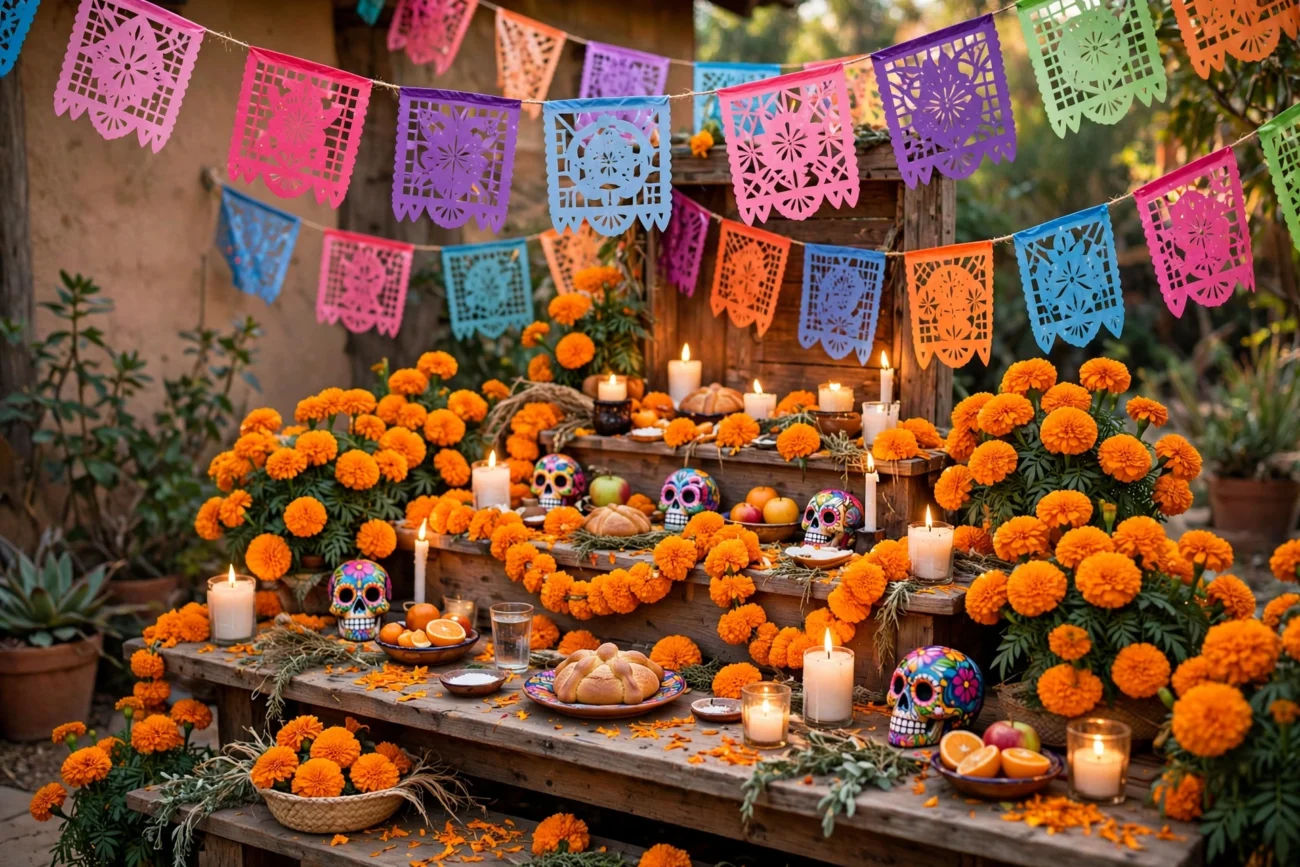
The ofrenda — the altar — is the heart of the whole celebration, and once you learn to read one, the holiday opens up like a book. Families build them at home, in cemeteries, and now at public festivals across the US. Nothing on them is decorative filler; every object is doing a job.
Photographs of the departed go at the center, so the returning spirits can find their way to the right house. Their favorite foods and drinks — a grandmother’s tamales, a father’s coffee, a kid’s candy — are laid out generously, based on the belief that the spirits consume the essence of what they loved in life. Nobody eats the offerings during the celebration itself; the nourishment is spiritual.
Pan de muerto, the sweet «bread of the dead» decorated with bone-shaped dough, is the holiday’s signature food. Candles and lanterns light the path home. Papel picado — those bright, fluttering cut-paper banners strung overhead — represents the fragility of life and adds a burst of color. Many families also include salt and water to quench the thirst of a long journey from the afterlife, sugar skulls inscribed with the names of the dead, and small personal belongings: a work hat, a guitar pick, a favorite book.
Some families describe the altar as holding the four elements — water in a glass, wind in papel picado, earth in marigolds, fire in candles. The framing varies, but the idea holds: the ofrenda is a fully stocked welcome, a way of saying you are still one of us.
Marigolds, Skulls, and the Lady in the Big Hat
Three symbols do most of the holiday’s visual heavy lifting, and each one is worth understanding before you photograph it.
Cempasúchil, the marigold, is the holiday’s guiding light — literally. The flowers’ blazing orange color and sharp, earthy scent are believed to help spirits find their way back to the living world. Families scatter petals in trails from the street to the front door, like runway lights for the returning dead. Around the holiday, Mexican grocery stores across the US turn into flower markets.
Calaveras — skulls and skeletons — are the part Americans misunderstand most. They are not horror props. The grinning skull is a joke on mortality itself: death comes for everyone, rich and poor, so we might as well laugh together. Poets even write calaveras literarias, satirical verses that playfully «kill off» the living with mock epitaphs. Laughter at death, together, keeps fear at arm’s length.
And then there’s La Catrina, the elegant skeleton lady in the feathered hat. She began as a satirical etching by Mexican printmaker José Guadalupe Posada around 1910–1913, mocking upper-class Mexicans who imitated European fashion while pretending death would somehow skip them. Diego Rivera later made her famous in his mural Dream of a Sunday Afternoon in Alameda Park. Today she’s the most recognizable figure of the holiday — and a reminder that the Day of the Dead has always had a sense of humor about class and pretense.
Where to Experience It in the US
The holiday crossed into the US the way culture always crosses: carried by Mexican and Mexican American families who kept building ofrendas wherever they landed. Over the decades, family and neighborhood observances grew into some of the country’s most beloved public festivals. Like so many of the American traditions that surprise visitors, it settled in through migration, food, and neighborhood life — and stayed because everyone who witnessed it wanted in.
Los Angeles is the holiday’s unofficial American capital. Hollywood Forever Cemetery hosts a long-running festival — more than a quarter-century of annual editions — drawing tens of thousands of people for community-built altars (well over 100 in recent years), Aztec dance processions, art exhibitions, and music until midnight. Across town, Olvera Street — widely considered the oldest street in LA — has marked the holiday with community altars for nearly four decades, at a gentler, family-friendly pace.
San Antonio, Texas, hosts Muertos Fest at Hemisfair, founded in 2013 and now one of the largest Day of the Dead celebrations in the country, drawing more than 100,000 visitors to 80-plus community altars, five stages of music, and two signature processions. The nearby Historic Market Square runs its own celebration the same weekend, so one trip covers both.
Chicago offers a more reflective experience. The National Museum of Mexican Art in the Pilsen neighborhood has staged an annual Day of the Dead exhibition for decades — its 40th anniversary edition carried the title Where Memory Lives. The surrounding Pilsen streets, covered in murals and lined with taquerias, make the visit a full-day immersion.
San Diego’s Old Town hosts community celebrations with altars, cultural performances, and traditional foods. On the East Coast, Brooklyn’s Green-Wood Cemetery holds a free family celebration on November 2 itself, centered on a large community ofrenda.
One careful distinction: Tucson’s All Souls Procession is often listed alongside these, but it’s a separate tradition — a massive, human-powered night procession started in 1990 by artist Susan Johnson to honor her late father. It draws inspiration from Día de los Muertos, but it has its own story, and it happens on its own date. Worth experiencing, just don’t confuse the two.
How to Show Up Respectfully
The holiday welcomes outsiders — hospitality is baked into it — but appreciation and appropriation are different things, and the line runs through your intentions.
Don’t treat it like Halloween. Skull makeup (calavera makeup) is part of the tradition, and having your face painted at a festival is generally welcomed. Wearing it as a sexy-or-spooky party costume to a bar is where it crosses the line — the skull carries specific meaning, and wearing it as decoration is where celebrants object.
Ask before you photograph. Altars are personal memorials. A quick, polite «may I take a photo?» goes a long way, and a «no» is final. Never touch or rearrange anything on an ofrenda, even for a better picture.
Cemeteries are family living rooms that night. Keep your voice low around families at graves, don’t interrupt ceremonies, and remember that the drinking you’ll see is ceremonial and social — not a tailgate.
Participate, don’t spectate. Taste the pan de muerto, learn what the marigolds mean. Buy from the vendors, tip the musicians, and support the Mexican and Mexican American organizations behind these events. Showing up curious beats showing up with a camera.
What Visitors Should Know Before You Go
A few practical notes:
- The holiday itself is November 1–2, but most US festivals happen on the weekends around those dates — sometimes the weekend before. Always confirm the date on the organizer’s site.
- Some events are ticketed. Hollywood Forever uses timed entry and recent editions have sold out, so buy ahead. Many others are free.
- Bring a photo of someone you miss. Many community altars welcome offerings from visitors, and contributing a picture of a grandparent or old friend is one of the most moving ways to take part.
- Arrive early, bring cash, wear comfortable shoes. These are outdoor, all-day events with crowds that grow every year.
The Day of the Dead endures in the US because it answers a need American culture rarely meets: a way to grieve that includes laughter, a way to remember that includes a feast. Go once, bring flowers, and leave understanding why the marigolds matter.
