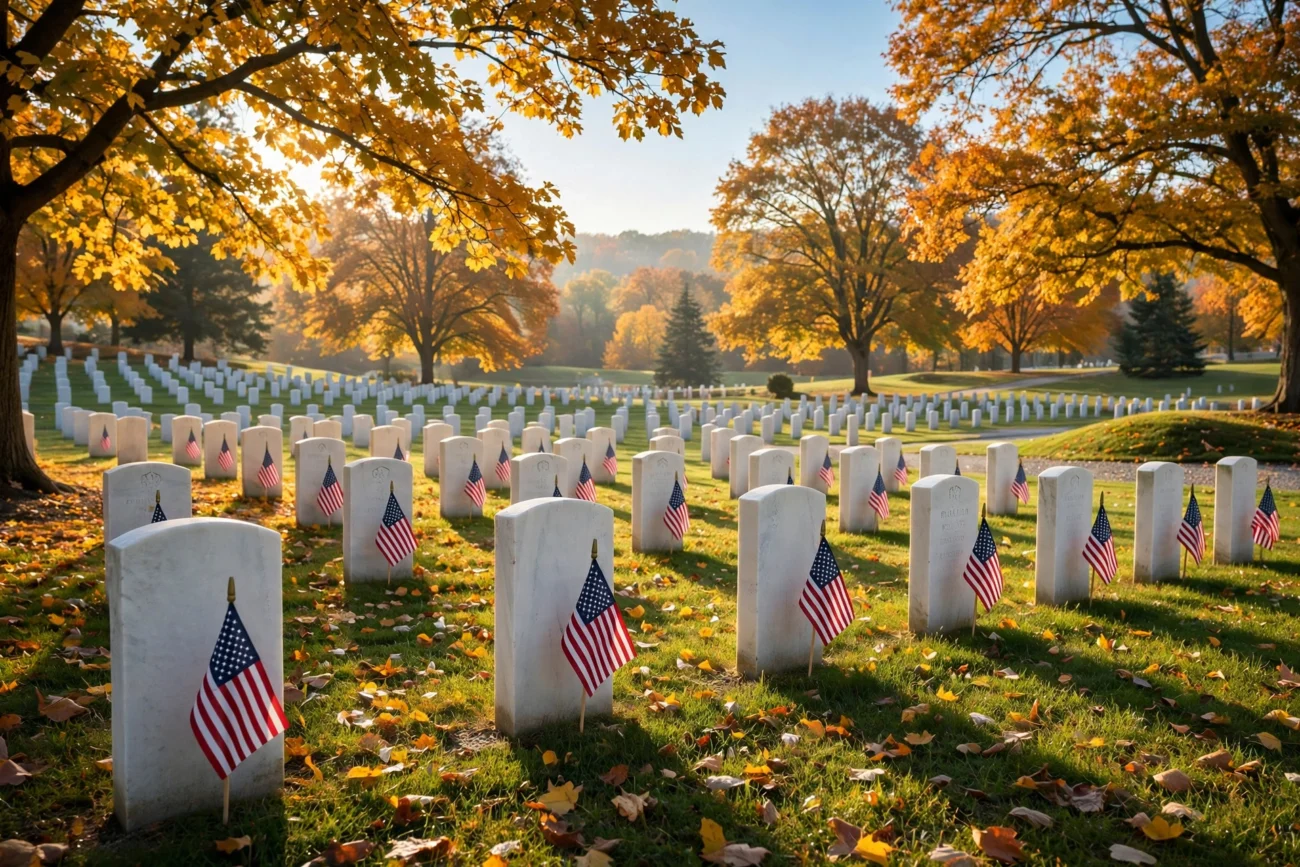
Every year, on the eleventh day of the eleventh month, at the eleventh hour, America pauses — not by design, but because that was when a terrible war finally stopped, and the clock remembered it.
At 11 a.m. on November 11, 1918, the guns on the Western Front fell silent. The date stuck because the moment stuck. This is the story of how a ceasefire became a holiday, how one war’s day became every veteran’s day, and how Americans mark it today.
Why November 11, in one paragraph
On November 11, 1918, an armistice signed at Compiègne, France, took effect at 11 a.m., ending the fighting of World War I in what people called «the eleventh hour of the eleventh day of the eleventh month.» A year later, President Woodrow Wilson proclaimed the first Armistice Day, and in 1938 Congress made November 11 a federal holiday dedicated to world peace. After World War II and the Korean War, the day was broadened to honor veterans of all wars and renamed Veterans Day in 1954. Congress briefly moved the observance to a Monday in the 1970s, but the date was restored to November 11 in 1978, because for most Americans, the meaning was inseparable from the date itself.
The morning the guns stopped
The armistice of November 11, 1918, was a ceasefire, not a peace treaty. The fighting stopped, but the war was not formally settled until the Treaty of Versailles was signed in 1919. For soldiers in the trenches, the practical fact was simple and enormous: they were no longer being ordered forward into gunfire.
Signed at Compiègne, in northern France, in the early hours, it took effect at 11 a.m. Paris time. Celebrations broke out across the Allied world, as people poured into the streets and bells rang. A generation that had lived with casualty lists and telegrams at front doors finally saw them stop for one morning.
The phrase that captured it — «the eleventh hour of the eleventh day of the eleventh month» — gave people something exact to hold on to, a time they could return to each year.
Wilson and the first Armistice Day
A year later, in 1919, President Woodrow Wilson proclaimed the first Armistice Day, asking Americans to remember the anniversary with gratitude and reflection, and to hold two minutes of silence at 11 a.m. The idea was not a party. It was a pause.
That first observance set the tone the day has kept ever since. Armistice Day was about remembering what the war had cost and what the peace was supposed to mean. Parades and speeches were part of it, but at its center was something quieter: the recognition that the silence at 11 a.m. had been bought at an extraordinary price.
In those early years, the day belonged mainly to World War I veterans and their families.
How it became a federal holiday dedicated to peace
In 1938, Congress made November 11 a legal federal holiday, dedicated to the cause of world peace. The holiday was not framed simply as a celebration of victory, but as a commitment — a day set aside each year to honor those who had served and to keep the hope of peace in front of the country.
By then, Armistice Day was already observed in many states and communities. Making it federal gave it a permanent place on the national calendar and fixed the date in law: November 11 itself, not a convenient nearby weekend — because moving it would break its connection to the event it commemorates, as the country would discover again decades later.
Why one war’s day became every veteran’s day
After World War II and the Korean War, it became clear that Armistice Day no longer fit the country it served. Millions of Americans had served in wars that had nothing to do with 1918, and a day dedicated only to World War I veterans left them out.
The push to broaden it is often associated with Raymond Weeks, a Navy veteran from Birmingham, Alabama, who organized a 1947 celebration honoring veterans of all wars. Towns had no separate parades for separate wars — just one main street, one memorial, and neighbors who had served in different conflicts and decades.
In 1954, Congress renamed Armistice Day as Veterans Day, and President Dwight D. Eisenhower signed the change into law as Public Law 83-380. From then on, November 11 honored American veterans of all wars — not only World War I veterans, and not only those who had died. That last point is the heart of the modern holiday, and the one most often misunderstood.
The Monday experiment and why Americans pushed the date back
In the late 1960s, Congress passed the Uniform Monday Holiday Act, which moved several federal holidays to Mondays to create three-day weekends. Veterans Day was swept into that change, and from 1971 its observance fell on the fourth Monday in October.
The change was practical, and it was unpopular. For many veterans’ groups and ordinary Americans, moving Veterans Day away from November 11 cut the thread tying the holiday to its history. A Monday in late October did not carry the eleventh-hour echo or fall on the anniversary of the armistice. It was simply a day off, and a day off was not the point.
Pressure to restore the date grew through the 1970s, and in 1975 President Gerald Ford signed a law returning Veterans Day to November 11, effective in 1978. Since then, the holiday has stayed where history put it, even midweek — as in 2026, when Veterans Day falls on Wednesday, November 11, 2026.
Veterans Day vs. Memorial Day vs. Armed Forces Day
Three holidays honor American military service, and they are easy to mix up. The distinctions are simple, and they matter to the people being honored.
Veterans Day, on November 11, honors all American veterans, living and dead, with the emphasis on the living — the men and women who served and came home. It is a day to thank a veteran you know.
Memorial Day, observed in May, honors those who died while serving in the United States Armed Forces. Its tone is more solemn, and that is why «Happy Memorial Day» can land awkwardly: for families who lost someone, it is not a happy day. Armed Forces Day, also observed in May, honors those currently serving. Put simply: Armed Forces Day is for those serving now, Memorial Day is for those who died in service, and Veterans Day is for all who served, especially those still with us.
How Americans actually observe it today
Observance varies by town, but the shape of the day is familiar: parades with veterans marching and school bands playing, school and community assemblies, and wreaths laid at memorials by local veterans’ organizations.
At the national level, the National Veterans Day Ceremony takes place at Arlington National Cemetery, including a wreath-laying at the Tomb of the Unknown Soldier — a grave for a soldier whose name was never known, honored on behalf of all who were never identified.
For most Americans, the day is smaller and more personal: a ceremony, a memorial visit, a flag at home, or a moment at 11 a.m. — and, most commonly, a sincere, in-person thank you to a veteran.
Like other American traditions, Veterans Day can look puzzling from the outside, a solemn ceremony and a parade on the same day. The two moods belong together. Early November is a reflective stretch of the year: families mark the Day of the Dead in the US by remembering loved ones who have died, and only weeks later gather for Thanksgiving, whose history is explored in the story of why Thanksgiving dinner looks the way it does.
What to say — and what not to say — to a veteran
If you want to mark Veterans Day well, the best place to start is a conversation, and the best rule is to keep it simple and sincere.
A plain «Thank you for your service» is welcome. If you know the person, something more personal is even better. Veterans are not a single group with a single experience: some served in combat, some never left the United States, some served for a few years and some for a career. Treat each person’s service as their own story, rather than assuming you know what it was like.
A few things are best avoided. Do not ask whether they killed anyone, or press for combat details they have not offered. Do not assume every veteran is struggling, or that every veteran wants to talk about their service at all. Some do, warmly and at length. Others would rather talk about their kids, their work, or the football game. Let them lead.
And do not confuse the holidays. On Veterans Day, the person in front of you is alive, and the day is partly for them. If you are unsure what to say, keep it simple: thank you, I appreciate it, and I am glad you are here.
A silence worth keeping
More than a century after the guns stopped, the reason for November 11 has not changed. It began as a ceasefire, became a day for peace, grew into a day for every veteran, survived a move to Mondays, and came home to its original date. Through all of that, the core idea held: at 11 a.m., on the eleventh day of the eleventh month, a country stops for a moment and remembers.
This November 11, whether you attend a parade, watch the Arlington ceremony, or simply pause at 11 a.m., you are taking part in one of America’s oldest acts of shared memory. The silence lasts only a moment. The gratitude is meant to last all year.
